

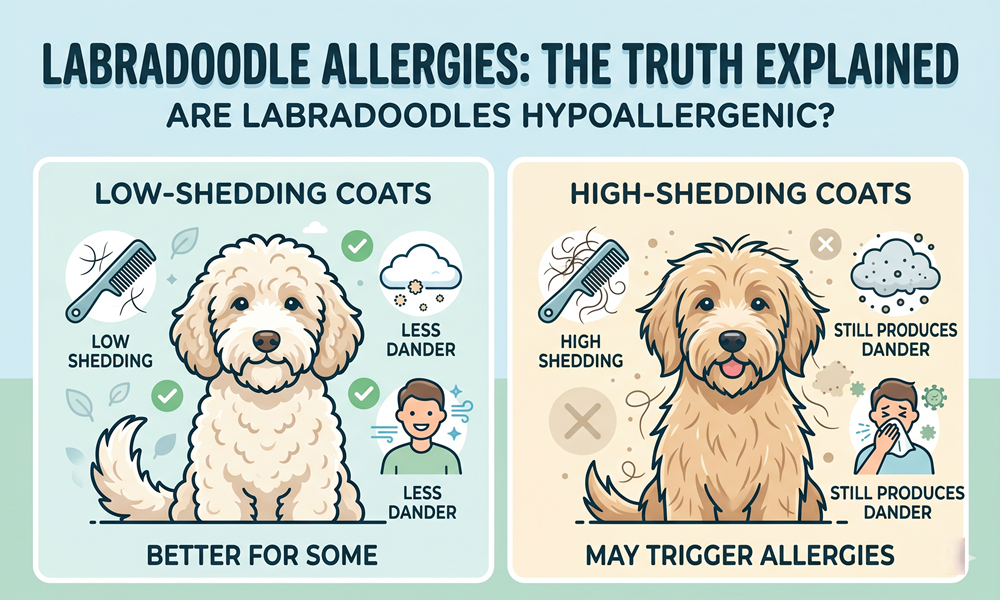
Hypoallergenic is one of the most commonly used and most frequently misunderstood words in dog breed marketing. For families with allergies who have been drawn to Labradoodles specifically because of that claim, it is worth understanding what the word actually means, what the science says about dog allergens, and what the genuine advantages of a Labradoodle coat are for allergy sufferers before making a decision.
The short answer is that no dog is truly hypoallergenic. The longer answer is considerably more useful, and for many allergy-prone families, it is also more encouraging than that headline suggests.
What People Are Actually Allergic To
Most people who believe they are allergic to dog fur are actually reacting to a protein called Can f 1, which is produced primarily in dog saliva, skin cells (dander), and urine. Fur itself is not the allergen. It is the vehicle that carries dander and dried saliva particles into the air and onto surfaces in your home. Dogs that shed heavily distribute more of these particles into the environment, which is why shedding is directly correlated with allergic symptoms for many people.
This is the basis for the hypoallergenic claim attached to low-shedding breeds. Fewer shed hairs in the environment means fewer allergen-carrying particles circulating in the air and settling on furniture, bedding, and clothing. It does not mean the dog produces no allergens. It means the mechanism of exposure is reduced.
Where the Labradoodle Coat Comes In
Labradoodles are crosses between Labrador Retrievers and Poodles. Labrador Retrievers are moderate to heavy shedders with a dense double coat. Poodles have a single-layer curly coat that sheds minimally and traps shed hair within the curl rather than releasing it into the environment. The degree to which a Labradoodle inherits the Poodle’s coat characteristics depends heavily on the generation of the cross and the specific genetics of the breeding pair. This is why coat type, and by extension shedding tendency, varies considerably between individual Labradoodles. Quality Labradoodle breeders pay close attention to coat genetics across generations and can give prospective buyers an honest assessment of the likely coat type of a specific litter.
A Labradoodle with a fleece or wool coat, which most closely resembles the Poodle parent’s coat, sheds minimally and is the type most commonly described as low-allergen. A Labradoodle with a flatter, more hair-like coat, which reflects a stronger Labrador influence, sheds more and distributes more allergens into the home environment. Assuming all Labradoodles are equally low-shedding is a mistake that leads to disappointing outcomes for allergy-sensitive families.
Generation Matters More Than Most Buyers Realise
Labradoodle generations are typically described as F1, F1B, F2, and beyond. An F1 Labradoodle is a first-generation cross between a purebred Labrador and a purebred Poodle. Coat outcomes in F1 litters are highly variable because genetics from both parent breeds are expressed in different combinations across the litter. Some F1 puppies will have fleece coats; others will have flatter, more Lab-like coats.
An F1B Labradoodle is the result of crossing an F1 Labradoodle back to a Poodle, which increases the proportion of Poodle genetics and significantly increases the likelihood of a low-shedding fleece or wool coat. F1B Labradoodles are generally considered the most reliably low-shedding generation and are the preferred choice for allergy-conscious buyers. Multigeneration Labradoodles, bred across several generations of Labradoodle-to-Labradoodle or Labradoodle-to-Poodle crossings, can achieve even greater coat consistency when the breeding programme is managed carefully.
Practical Steps for Allergy-Prone Families
Even with a low-shedding Labradoodle, families with significant dog allergies should take some practical steps to minimise exposure. Keeping the dog out of bedrooms, washing hands after handling, vacuuming regularly with a HEPA-filter machine, and grooming the dog frequently to prevent dander buildup are all effective measures that reduce ambient allergen levels.
The most reliable thing an allergy-prone family can do before committing to a puppy is spend time with adult Labradoodles from the same breeder and from a similar generation to the puppy they are considering. Individual reactions vary between people and between dogs. A direct exposure test is more informative than any general description of the breed’s allergen profile.
Some people with mild to moderate dog allergies live happily with low-shedding Labradoodles for years without significant symptoms, particularly in homes where the dog is groomed regularly and the environment is managed. People with severe or highly reactive allergies should approach the decision more cautiously and prioritise direct exposure testing before purchase.
For families doing their research before making a decision, understanding how Labradoodles are bred and raised gives important context about the care taken in selecting breeding pairs, the health standards maintained across generations, and the coat types likely to be available in upcoming litters. That information, combined with a direct visit and exposure test, gives allergy-conscious buyers the most accurate basis for their decision.
